 America
 By
By 
For most people the SunHome Smith machine is the best all-in-one — the biggest owner base in the class with a cage, Smith bar, pulldown and crossover in one frame. The pooboo system is the best-rated with the strongest cable setup, and the RitFit half-rack Smith is the pick for tighter spaces.
How These Picks Were Chosen
Bar-path smoothness and catch design first, because a Smith machine is its rails — grinding carriages are the category's defining complaint. Then what surrounds the bar: cable stations, pulldown, storage. Then footprint and ceiling needs, and assembly, which owners consistently report as a long day. High-ticket machines accumulate reviews slowly, so bases here are smaller than our usual bar and we say so plainly.
1. Best Overall: SunHome Smith Machine Power Cage (2000 lb, LAT & Crossover)
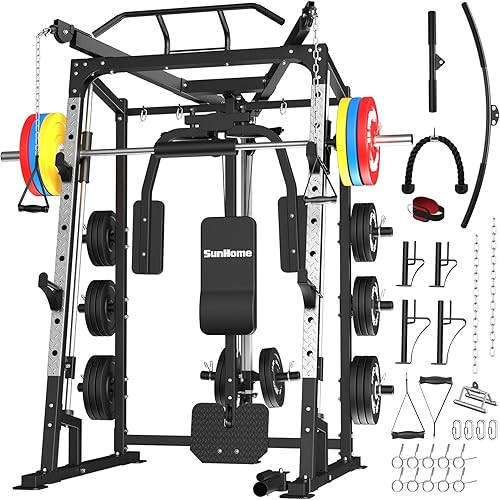
SunHome Smith Machine Power Cage (2000 lb, LAT & Crossover)
SunHome · 4.3★ from 442 verified ratings
- Smith bar + full power cage in one frame
- LAT pulldown and cable crossover
- 2000 lb stated frame rating
- Largest owner base in the class
- Plate storage on the frame
Why we picked it: The SunHome is the format's best seller for a reason: it does not make you choose between a Smith bar and a free-weight cage, because the frame is both, with a pulldown and crossover cables around it. Four hundred reviews is modest by our usual standard and the largest base this class has — the machines are simply too new and too expensive to have more. The known trade-offs: assembly is a genuine half-day-plus, and the Smith bar runs on bushings that want occasional lubrication.
2. Best Rated: pooboo Power Cage Smith Machine with Dual Pulley Crossover

pooboo Power Cage Smith Machine with Dual Pulley Crossover
pooboo · 4.9★ from 82 verified ratings
- 4.9★ — highest rating in the class
- Dual-pulley crossover with LAT pulldown
- Adjustable stations and attachments
- 2000 lb stated rating
- Smoothest-reviewed cable feel
Why we picked it: pooboo's system earns the highest rating in the category, and the reviews are specific about why: the cables and pulleys feel better than the class norm, which matters because the cable stations are what you use between Smith sets. The base is under a hundred owners on the current listing — early-adopter territory, and we flag it as such. If the rating holds as the base grows, this becomes the default recommendation.
3. Best for Smaller Rooms: RitFit Half-Rack Smith Machine with LAT Pulldown
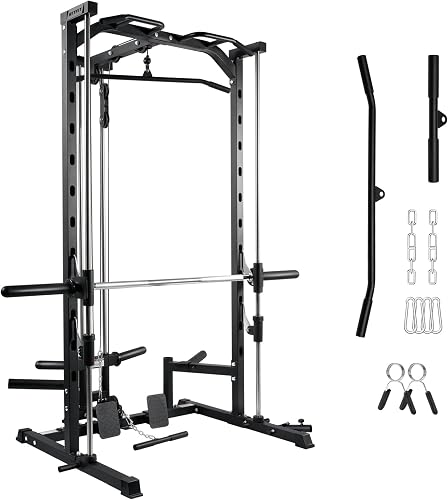
RitFit Half-Rack Smith Machine with LAT Pulldown
RitFit · 4.6★ from 60 verified ratings
- Half-rack footprint
- Smith bar with pulldown and landmine
- Barbell and plate storage pegs
- The brand the category is searched by
- Fits under lower ceilings than full cages
Why we picked it: RitFit is the name people actually type into search when they look for home Smith machines, and this half-rack model is why it belongs here: it delivers the guided bar, a pulldown and a landmine in a frame that fits rooms the full cages cannot. Smaller footprint means no full cage safeties for free-weight work and the smallest review base in this guide — both stated plainly. For the spare room rather than the garage, it is the right shape.
Side-by-Side Comparison
| Pick | Model | Format | Rating | Footprint | Best for | See price |
|---|---|---|---|---|---|---|
| Best Overall | SunHome | Cage + Smith + cables | 2000 lb stated | Large | The full all-in-one | Check price |
| Best Rated | pooboo | Cage + Smith + dual cables | 2000 lb stated | Large | Cable-heavy training | Check price |
| Best for Smaller Rooms | RitFit | Half rack + Smith | Frame-rated | Compact | Spare rooms, lower ceilings | Check price |
Buying Considerations
The rails are the machine. A Smith carriage that binds or grinds ruins every rep on it. Owner reviews mentioning smoothness — or lubrication fixing early stiffness — are the most useful sentences you can read before buying one. Expect to lubricate the rails periodically regardless of brand.
Angled or vertical bar path changes the feel. Many machines run the bar on a slight angle to better match a natural squat and press path; some run dead vertical. Neither is wrong, but they feel different — check which you are buying and which way the angle faces for your main lifts.
Count the whole footprint, including the cable arms. Listings quote the frame; crossover arms and the space to actually use a pulldown add real inches on every side. Sketch the room before ordering, and check ceiling height against the pulldown's top pulley, not the frame.
Budget a real assembly day. These arrive as several hundred kilograms of boxed steel, and owner reviews consistently describe four to eight hours of assembly, easier with two people. Machines with clear labeling and pre-attached hardware earn their reviews here; a helper earns theirs.
Buyer’s Guide: How to Choose a Home Smith Machine
A home Smith machine is a big purchase that is hard to return. These checks, in this order, avoid the common mistakes.
1. Check the height against your ceiling first
Home Smith machines commonly run in the low-to-mid 80-inch range. A standard 8-foot ceiling is 96 inches, so most fit — but the frame is not the only number. The top pulley on the lat pulldown, a pull-up bar on top of the frame, and bolts that stick up all add height. If you plan to do pull-ups on the frame, add about a foot above the bar for your head. Our home gym ceiling height guide has the arithmetic for every machine type.
2. Measure the full footprint, including cables
Listings quote the frame. Crossover arms, plate storage and the room to stand at a cable station add space on every side. Tape the real footprint on your floor before you order.
3. Read reviews for the bar path
The Smith bar runs on rails. If the carriage binds or grinds, every rep suffers. Owner reviews that describe a smooth bar — or say that lubricating the rails fixed early stiffness — are the most useful sentences on the page.
4. Decide how much you will use the cables
All-in-one machines add a lat pulldown, low row and crossover cables. If you will train with them often, cable feel matters as much as the Smith bar. If you mainly want a guided squat and bench, a simpler machine saves space and assembly time.
5. Check the safeties
The point of a Smith machine at home is training alone safely. Look for adjustable safety stops along the full height of the rails and hooks you can rotate into place at any point in a rep.
6. Plan the delivery and assembly
These machines arrive in several heavy boxes. Owners regularly report four to eight hours of assembly, and most say a second person helps. Check that the boxes can reach the room you have in mind.
What We’d Skip
Machines with no published height. If a listing will not tell you how tall the machine is, do not order it for a room with a standard ceiling.
Rails with repeated binding complaints. A rough bar path rarely improves much with use, and it makes the main feature of the machine unpleasant.
Stack-loaded systems with a tiny stack. A small built-in weight stack can be outgrown quickly. Plate-loaded cables grow with you.
Buying a Smith machine to replace free weights. The fixed bar path is safer for training alone, but it does less for balance and stabilizer muscles. Most home lifters do best with the cage and Smith bar together, which is why our picks are combination machines.
Setup, Space and Upkeep
Level the frame. Build the machine where it will live, on a level floor. An unlevel frame makes the bar track badly and the whole machine creak.
Protect the floor. Put rubber flooring under the full footprint. It spreads the load and stops the frame moving. Our flooring guide covers the options.
Lubricate the rails. Wipe the rails clean and apply a light lubricant on the schedule the manufacturer recommends, or sooner if the bar starts to feel sticky.
Re-check bolts and cables. Re-tighten frame bolts after the first few weeks, and check cables and pulleys for fraying or noise every month.
Leave working room. Keep space in front of the machine for loading plates and stepping in and out, and space behind cable stations so you can step back during exercises.
Who Should Buy Something Else
You want free-weight training first. A power rack or squat rack with a barbell is simpler, cheaper and trains stabilizer muscles better.
You mainly want cable work. A functional trainer or cable machine gives you more cable options in less space.
You want one machine that does almost everything. Our all-in-one home gyms roundup covers systems built around a weight stack.
You are still choosing the room. Read our garage gym planning guide before buying any large machine.
So Which One Should You Buy?
For most people: the SunHome Smith Power Cage. Cage, Smith, cables — the whole gym in one frame.
Best cable feel: the pooboo Smith System. Highest rated in the class, early but promising.
Tighter spaces: the RitFit Half-Rack Smith. The guided bar in a footprint that fits.
Ready to buy?
Jump straight to our picks on Amazon — check the current price at click-through.
FAQ
What are the best smith machines in 2026?
The SunHome Smith Machine Power is our best overall (4.3★ from 442 ratings): smith bar + full power cage in one frame. If that is not the right fit, pooboo Power Cage Smith covers the best rated case and RitFit Half-Rack Smith Machine the best for smaller rooms. We verify listings rather than lab-test, which is why the reasoning is on the page.
Is a Smith machine good for a home gym?
For a solo lifter it solves a real problem: the guided bar and built-in catches let you push near your limit on squats and presses with no spotter and very little risk of being trapped under a bar. The trade is a fixed path that does less for stabilizer muscles — which is why the all-in-one machines pair it with free-weight cages and cables.
Is the Smith machine bar weight the same as a barbell?
No — the counterbalancing and carriage mean the starting resistance varies by machine, often lighter than a standard bar, sometimes heavier. Treat the machine's numbers as internally consistent and do not compare them to your barbell lifts.
How much space does a Smith machine need?
Plan on a footprint meaningfully larger than the listed frame dimensions once cable arms and working room are counted, and check ceiling height against the tallest pulley. Most full systems want a garage-height ceiling; the half-rack formats are the answer below that.
Are budget Smith machines safe?
The stated frame ratings are far beyond home loads, and the guided-bar format is inherently protective. The realistic risks are assembly errors and neglected maintenance — bolts loosening and rails running dry. Torque-check after the first weeks of use and lubricate the rails on schedule.
Smith machine or power cage — which should I buy?
If you can only have one and you train alone, the modern answer is increasingly both-in-one-frame, which is what this guide covers. A pure power cage with a barbell builds more stabilizer strength and costs less; a Smith adds guided safety and cable variety. Our squat rack guide covers the pure-cage path.
What ceiling height does a home Smith machine need?
Check the specific model, but most home Smith machines are in the low-to-mid 80-inch range, so they fit under a standard 8-foot (96-inch) ceiling. Add any pull-up bar or top pulley to the frame height, and allow about a foot above the bar if you plan to do pull-ups on the frame.
Can a Smith machine fit in a basement?
Often, but measure to the lowest point: joists, ducts or beams, not the drywall. Under 7 feet, a full Smith machine is unlikely to fit; a half-rack style machine or a short power rack is a better choice.
Do Smith machines need to be bolted down?
Most home Smith machines are designed to stand freely because of their size and weight. Bolting can help if you train heavily on the cable stations. Follow the manufacturer’s guidance and keep the frame on a level floor.


How We Research
Picks are researched and written by Mike Callahan based on manufacturer specifications, current Amazon listings, and patterns across verified owner reviews — particularly the negative ones. We are not a testing lab and do not claim to be; our full standard is in the editorial policy. Specifications and included accessories vary by listing, so confirm current details at the retailer before buying.
Note: All-in-one Smith systems are new enough that review bases are small across the entire class — the picks here are the best-evidenced available, not deeply validated products, and we have said so per pick. Frame ratings are manufacturer-stated. Confirm boxed weights, footprint and ceiling requirements at the retailer, and plan assembly help. Ratings verified on the live listings October 1, 2026; the pooboo and RitFit counts fell on their current listings, and both are disclosed on their cards.