 America
 By
By 
For most people the Sunny Health & Fitness multifunctional rack is the best buy — a full cage with attachments, at 4.7★ across nearly 4,000 ratings. The CAP Barbell power rack is the best value, and the F2C adjustable stands are the best budget and small-space option.
Our Selection Criteria
Safety first: whether the rack has proper catches or spotter arms you can bail a failed rep onto. Then footprint and required ceiling height, then stated capacity as a proxy for steel gauge and welding, then attachment options. Every pick has thousands of verified ratings with no pattern of structural complaints.
1. Best Overall: Sunny Health & Fitness Multifunctional Power Rack Cage
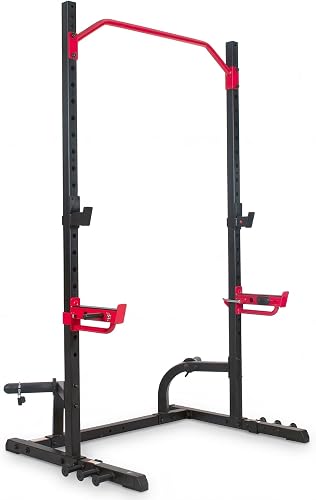
Sunny Health & Fitness Multifunctional Power Rack Cage
Sunny Health & Fitness · 4.7★ from 3,886 verified ratings
- Full power cage with safety catches
- Training attachments included
- Optional squat stand configuration
- Adjustable incline bench available
- 4.7★ across 3,886 ratings
Why we picked it: A full cage is the safest way to train alone, because a failed squat or bench press lands on the catches rather than on you. This one arrives with attachments rather than as a bare frame, which is what makes the price notable — comparable cages usually cost more before you add anything. At 4.7★ across nearly 4,000 ratings it is the best-rated rack in this guide.
2. Best Value: CAP Barbell Power Rack

CAP Barbell Power Rack
CAP Barbell · 4.5★ from 4,562 verified ratings
- Established budget-rack brand
- Adjustable J-hooks and safeties
- Attachment options available
- Over 4,500 verified ratings
- Widely documented assembly
Why we picked it: CAP has been the default budget rack brand in the US for years, and the practical benefit is that everything about this rack is well documented — assembly quirks, attachment compatibility, what fits and what does not. It is less refined than the Sunny cage and the finish shows the price, but the geometry is sound and the safeties do their job.
3. Best Budget: F2C Adjustable Squat Stands, 550 lb (Pair)

F2C Adjustable Squat Stands, 550 lb (Pair)
F2C · 4.3★ from 3,986 verified ratings
- Adjustable 41–66 in height
- 550 lb stated capacity
- Move and store easily
- Works under low ceilings
- Nearly 4,000 verified ratings
Why we picked it: Independent stands are the answer when a cage will not fit — low ceilings, a shared garage, or a space you need to clear after every session. They adjust from 41 to 66 inches and pack away in a corner. The honest limitation is that stands offer no safety catches, so you must be conservative with load or add separate spotter arms. Do not treat them as a cage substitute for maximal work.
Specs at a Glance
| Pick | Model | Type | Safeties | Footprint | Best for | See price |
|---|---|---|---|---|---|---|
| Best Overall | Sunny Health & Fitness | Full cage | Catches + attachments | Large | Training alone, safely | Check price |
| Best Value | CAP Barbell | Power rack | J-hooks + safeties | Large | Value without unknowns | Check price |
| Best Budget | F2C | Squat stands | None — no catches | Minimal | Low ceilings, tight spaces | Check price |
What Actually Matters
Safeties are not optional if you train alone. A power cage with pin-and-pipe or strap safeties lets you fail a squat or a bench press and walk away. Squat stands without catches do not. If you lift alone and near your limit, this single feature matters more than everything else on the spec sheet.
Measure ceiling height before anything else. Most full cages need roughly 7 feet plus clearance, and if you plan to use the pull-up bar you need room to hang and to pull your head above it. Many garages with low joists simply cannot take a cage, which is what makes adjustable stands genuinely useful rather than merely cheap.
Steel gauge and hole spacing beat brand names. Lower gauge means thicker steel: 11-gauge is the commercial standard, 12–14 is typical at home-gym prices. Westside hole spacing (1 inch through the bench and squat range) lets you set safeties precisely, which matters most on bench press where the margin is small.
Decide about bolting down before you buy. Taller racks with a pull-up bar can tip when you kip or pull hard, and many manufacturers require anchoring. Check whether your slab can take anchors, and whether you are willing to drill — if not, prioritize a wider-footprint rack designed to stand free.
Bottom Line: Which Should You Buy?
For most people: the Sunny Multifunctional Rack Cage. Full cage with attachments, best rated here.
Best value: the CAP Barbell Power Rack. Known quantity, well documented, half the price.
Low ceilings: the F2C Adjustable Squat Stands. Fits where a cage cannot — but no catches.
Ready to buy?
Jump straight to our picks on Amazon — check the current price at click-through.
Frequently Asked Questions
What are the best squat racks in 2026?
Short answer: the Sunny Health & Fitness — 4.7★ from 3,886 ratings. Its case: full power cage with safety catches. CAP Barbell Power Rack is the alternative worth comparing, with F2C Adjustable Squat Stands as the best budget. All picks were verified on their live listings; availability and ratings move, so check before you buy.
Do I need a full power cage or will squat stands do?
If you train alone and push close to your limit, a cage with safeties is the safer choice by a wide margin — you can fail a rep and walk away. Stands are appropriate when ceiling height or space rules out a cage, or when you stay well within your capabilities.
What ceiling height do I need for a squat rack?
Most full cages want around 7 feet or more, and using the pull-up bar needs additional headroom above that. Measure to the lowest obstruction — garage door tracks and joists catch people out far more often than the ceiling itself does.
Does a squat rack need to be bolted to the floor?
It depends on the rack. Taller racks with pull-up bars often specify anchoring, because pulling movements can tip them. Wider-footprint racks are usually designed to stand free. Check the manual, and if you cannot drill your slab, prioritize a rack rated for free-standing use.
What weight capacity do I actually need?
Capacity ratings are best read as a proxy for steel gauge and weld quality rather than as a target. A 550 lb rating on stands is plenty for the vast majority of home lifters; if you are approaching those numbers, you should be in a cage with proper safeties anyway.
Can I use a squat rack for bench press too?
Yes, and that is a large part of the value — but only with a bench that fits inside the rack and with safeties set correctly at chest height. Setting safeties for bench press takes more care than for squats because the margin between the bar and your chest is small.


How We Research
Picks are researched and written by Mike Callahan based on manufacturer specifications, current Amazon listings, and patterns across verified owner reviews — particularly the negative ones. We are not a testing lab and do not claim to be; our full standard is in the editorial policy. Specifications and included accessories vary by listing, so confirm current details at the retailer before buying.
Note: Racks are rated on stated capacity rather than measured steel gauge, and manufacturers do not always publish gauge, so we treated capacity and review history together as the best available proxy. Assembly quality and hardware are the most common complaint in this category. Confirm current dimensions, hole spacing and anchoring requirements at the retailer, and check your ceiling height before ordering.