 America
 By
By 
For most people the SPORTSROYALS power tower is the best buy — the most-owned tower on Amazon and the one whose reviews stopped complaining about wobble. The RELIFE tower is the proven value pick, and the BangTong&Li is the budget way in for lighter users.
How These Picks Were Chosen
Stability first, second and third: every negative pattern in this category is some form of wobble, so we read for it specifically — base width, steel gauge, and whether kipping or aggressive dips unseat the frame. Then stated capacity as a build proxy, height adjustability against ceilings, and pad quality on the dip and leg-raise stations. All three picks carry four-figure-to-five-figure bases.
1. Best Overall: SPORTSROYALS Power Tower (Pull-Up, Dip & Leg Raise Station)

SPORTSROYALS Power Tower (Pull-Up, Dip & Leg Raise Station)
SPORTSROYALS · 4.4★ from 18,135 verified ratings
- The most-owned tower on Amazon
- Wide, stable base geometry
- Multi-grip pull-up bar
- Padded dip and leg-raise stations
- 18,000 verified ratings
Why we picked it: Eighteen thousand ratings make this the reference tower, and the reviews tell the story that matters: the wide-stance base holds still under strict pull-ups and dips, which is precisely where cheaper towers fail. Like every tower, it rewards strict form — swing hard enough and physics wins — but as a home station for the pull-dip-raise triad it is the category's proven answer.
2. Best Value: RELIFE Free Standing Power Tower

RELIFE Free Standing Power Tower
RELIFE · 4.4★ from 8,449 verified ratings
- Height-adjustable frame
- 8,000+ verified ratings
- Same 4.4★ as the class leader
- Multi-station: pull-ups, dips, push-ups
- The brand its own keyword searches for
Why we picked it: RELIFE matches the SPORTSROYALS rating with nearly half the price positioning historically, and its adjustable-height frame fits lower ceilings and shorter users better than the fixed-height leader. The base is a touch narrower, and its reviews show slightly more wobble mentions at the tall settings — set it low if you are heavy-handed on dips. For most budgets this is the sweet spot.
3. Best Budget: BangTong&Li Power Tower (Pull-Up & Dip Stand)
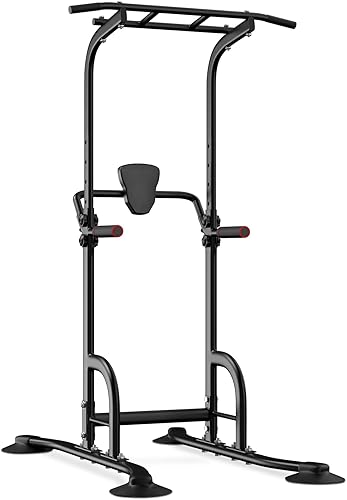
BangTong&Li Power Tower (Pull-Up & Dip Stand)
BangTong&Li · 4.3★ from 7,151 verified ratings
- 7,000+ verified ratings
- Compact footprint
- Adjustable height
- Covers all four stations
- Cheapest credible tower on the market
Why we picked it: The BangTong&Li is what the budget end of this category looks like when it is done honestly: thinner steel and a narrower base than the picks above it — its reviews say so and so do we — but assembled correctly and used with strict form by light-to-average users, it holds up across seven thousand owners. It is the tower for testing whether tower training sticks, not for a heavy kipping practice.
Side-by-Side Comparison
| Pick | Model | Base | Pull-up bar | Ratings | Best for | See price |
|---|---|---|---|---|---|---|
| Best Overall | SPORTSROYALS | Wide base | Multi-grip | 18,000 | Most people | Check price |
| Best Value | RELIFE | Adjustable height | Standard | 8,449 | Value, lower ceilings | Check price |
| Best Budget | BangTong&Li | Compact | Standard | 7,151 | Lighter users, first tower | Check price |
Buying Considerations
Wobble is the whole category. A tower is a lever with you swinging on top of it. Base width and depth, steel gauge, and cross-bracing decide whether it stands still; reviews mentioning wobble at your body weight are disqualifying. If your form includes kipping, no free-standing tower is the right tool — see a mounted bar instead.
Stated capacity is a build proxy, not a target. Ratings in the hundreds of pounds describe static load, not a bodyweight in motion. Choose a tower rated well above your weight, and read the negative reviews at the weight you actually are.
Check total height against your ceiling — and your chin. The bar must clear your head at the top of a rep, and the frame must clear your ceiling. Adjustable-height frames solve basements; fixed-height frames are usually more rigid at their one height. Measure before choosing which trade you want.
The floor matters more than people expect. Towers walk and mark hard floors under vigorous use. Rubber flooring or a mat under the base quiets it, protects the floor, and adds a little friction against sliding — see our gym flooring guide.
Buyer’s Guide: How to Choose a Power Tower
The picks above are the towers with the deepest records. If you are comparing other listings, these checks will sort them quickly.
1. Measure the base before the height
Stability comes from base width and depth more than from steel thickness. A wide, deep base with outriggers front and back resists the forward rock you get at the bottom of a dip and the swing at the bottom of a pull-up. When two towers look alike, the bigger footprint is usually the steadier one — at the cost of floor space.
2. Fit the tower to your ceiling, then your body
You need two clearances: the frame must fit under the ceiling, and your head must clear the ceiling at the top of a pull-up. That second number is bar height plus roughly a foot. Adjustable towers solve low rooms; just remember they tend to be steadiest at their lower settings. Our home gym ceiling height guide has the full arithmetic.
3. Check the bar for your grip
A straight bar is fine for pull-ups. Angled or multi-grip handles let you train neutral-grip pull-ups, which many people find easier on the elbows and shoulders. Foam grips are comfortable but wear; bare knurled steel lasts longer.
4. Look at the dip station width
Dip handles that are too wide put the shoulders in an awkward position. Some towers let you adjust the dip width; most do not. Owner reviews from broad-shouldered and narrow-shouldered users tell you whether the fixed width suits you.
5. Treat stated capacity as a stiffness signal
Capacity numbers are static ratings, not bodyweight in motion. A higher rating usually means stiffer tubing and better welds, which shows up as less flex during dips. Choose a tower rated well above your weight.
6. Read the one-star reviews for assembly, not breakage
Most bad tower reviews describe wobble, and many of those trace back to assembly: bolts tightened out of sequence or a frame built on an uneven floor. A pattern of bent parts or welds failing is a different matter and worth avoiding.
What We’d Skip
A tower for kipping or muscle-ups. Free-standing towers are built for strict reps. Dynamic movements need a bar bolted to the wall, ceiling or a rack. See our pull-up bar roundup for mounted options.
The narrowest, lightest frames. If a tower’s base is barely wider than its uprights, it will rock under dips no matter how carefully you assemble it.
Towers with a single fixed height that does not fit your room. If the frame is close to your ceiling, you will hit your head on every pull-up. An adjustable frame set lower is the better buy.
Extra stations you will not use. Sit-up benches and resistance-band hooks bolted onto a tower add weight and parts. If the core of your training is pull-ups and dips, a simpler tower is fewer bolts to loosen.
Setup, Space and Upkeep
Assemble on a level floor. Build the tower where it will live, snug the bolts first, check that it sits flat, then tighten everything fully. Owners who skip the leveling step are the ones who report wobble.
Re-tighten after the first week. Bolts settle as the frame takes load. Check them after a week of use and then every month or two.
Put something under it. Rubber flooring or a mat stops the feet sliding, protects the floor and quiets the frame. Our flooring guide covers options that work under a tower.
Give it room. Plan floor space for the tower plus about a foot and a half in front for leg raises and dips, and enough overhead for your head at the top of a pull-up.
Inspect the pads. The back pad and arm pads on the leg-raise station take the most wear. Wipe them after use and replace them if the vinyl splits.
Who Should Buy Something Else
You only want pull-ups. A doorway or wall-mounted bar costs less and takes no floor space. Our best pull-up bars roundup covers both.
You only want dips. A standalone dip station is smaller, lower and steadier for dips than a full tower.
You want the most training from the least gear. Gymnastic rings hung from a sturdy anchor cover pull-ups, dips, rows and push-ups, and pack into a bag.
You also want to squat and bench. A power rack includes a pull-up bar and accepts dip attachments, so it can replace the tower entirely in a garage gym.
So Which One Should You Buy?
For most people: the SPORTSROYALS Tower. The proven one — stable where cheap towers wobble.
Best value: the RELIFE Tower. Same rating, adjustable height, easier money.
On a budget: the BangTong&Li Tower. Honest entry point for lighter, stricter users.
Ready to buy?
Jump straight to our picks on Amazon — check the current price at click-through.
FAQ
What are the best power towers in 2026?
The SPORTSROYALS Power Tower is our best overall (4.4★ from 18,135 ratings): the most-owned tower on Amazon. If that is not the right fit, RELIFE Free Standing Power covers the best value case and BangTong&Li Power Tower the best budget. We verify listings rather than lab-test, which is why the reasoning is on the page.
Are power towers worth it?
If pull-ups and dips are in your training, very much so — they are the two highest-value bodyweight lifts, and a tower delivers both with no mounting, no door frame, and a leg-raise station besides. It earns floor space faster than almost anything else at its size.
Do power towers tip over?
A decent tower used with strict form does not. Tipping stories almost always involve kipping, explosive muscle-ups, or exceeding sensible load on a narrow-based budget frame. If your training is dynamic, wall- or ceiling-mounted equipment is the right tool instead.
What can you do on a power tower?
Pull-ups and chin-ups across the grip positions, dips, hanging leg raises and knee raises, and push-ups on the low handles. That covers back, chest, arms and core — a genuinely complete upper-body pattern from one frame.
How tall a ceiling do I need for a power tower?
Frame heights vary and adjustable models help, but remember your head travels above the bar at the top of a pull-up. Basement buyers should pick an adjustable frame and check the frame height plus a comfortable margin against their lowest joist.
Power tower or doorway pull-up bar?
The doorway bar is a fraction of the cost and disappears when not in use; the tower needs no door, adds dips and leg raises, and is kinder to trim. Renters with sound door frames often start with the bar — our pull-up bar guide covers those — and graduate to a tower when training sticks.
How much does a power tower need to weigh to be stable?
Weight helps, but base size matters more. A tower with a wide, deep base and front and back outriggers will rock less than a heavier tower with a narrow footprint. Assembly on a level floor and tight bolts make the biggest difference of all.
Can you do muscle-ups on a power tower?
It is not a good idea. Free-standing towers are designed for strict pull-ups and dips, and the swing and pull of a muscle-up can tip or walk the frame. Use a bar mounted to a wall, ceiling or rack for dynamic work.
What ceiling height do I need for a power tower?
Measure the tower’s height at the setting you will use, then add about a foot above the bar for your head at the top of a pull-up. Under 8-foot ceilings, choose an adjustable tower and set it low. Our ceiling height guide walks through the numbers.


How We Research
Picks are researched and written by Mike Callahan based on manufacturer specifications, current Amazon listings, and patterns across verified owner reviews — particularly the negative ones. We are not a testing lab and do not claim to be; our full standard is in the editorial policy. Specifications and included accessories vary by listing, so confirm current details at the retailer before buying.
Note: Tower stability depends heavily on assembly — bolts torqued in sequence on level floor — and a large share of wobble complaints trace to setup rather than steel. Capacity figures are manufacturer-stated static ratings. Confirm frame height and base dimensions against your space before ordering. Ratings verified on the live listings October 1, 2026.