 America
 By
By 
The Amazon Basics rope — nearly 9,000 owners — is the straightforward pick: choose your length and diameter and anchor it well. The Perantlb adds a full protective sleeve that garage and outdoor floors chew through unsleeved ropes to justify, and the cordless pick trades true rope feel for apartment-sized convenience — a real trade, stated plainly.
How These Picks Were Chosen
We held the 4.3 floor and picked across the category’s three real options: a proven bare poly rope, a sleeved rope for abrasive surfaces, and the new cordless format for spaces where thirty feet of laid-out rope is fantasy. Fraying reports drove the rope picks — sleeves and sealed handle caps are what negative reviews argue about — and for the cordless pick we weighted honesty about what it is: weighted handles simulating rope resistance, not a rope.
1. Best Overall: Amazon Basics Battle Rope
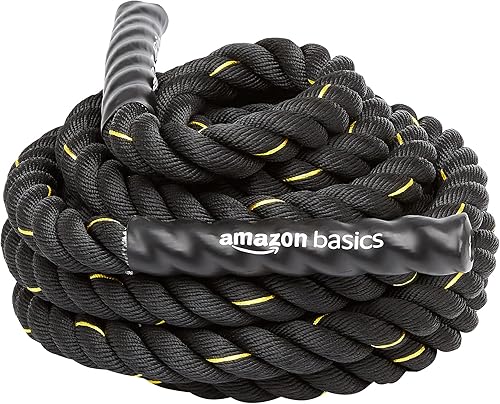
Amazon Basics Battle Rope
Amazon Basics · 4.7★ from 8,963 verified ratings
- Nearly 9,000 owners at 4.7 — the category benchmark
- Multiple length and diameter options on one listing
- Heat-sealed handle grips that survive slam work
- Poly-dacron build with honest durability reports
Why we picked it: Battle ropes are a simple product done well or badly, and this one’s five-figure-adjacent record says done well: poly-dacron strands that resist fraying, handles that stay sealed through slam sessions, and the length-and-diameter menu that lets you buy the workout you want. Trade-offs: bare rope on rough concrete or asphalt will still wear over time — that is physics, and the sleeved pick’s reason to exist — and you must solve anchoring yourself: a pole, a rack upright, or a dedicated anchor kit.
2. Best Sleeved: Perantlb Battle Rope with Cloth Sleeve

Perantlb Battle Rope with Cloth Sleeve
Perantlb · 4.8★ from 1,793 verified ratings
- Full-length protective sleeve shrugs off concrete
- Best rating on this page at 4.8
- 1.25 to 2-inch diameters up to serious thickness
- The outdoor and garage-floor answer
Why we picked it: Rope-on-concrete is a sanding operation, and the Perantlb’s full cloth sleeve is the fix — the sacrificial layer takes the abrasion while the rope inside stays structural. Owners using driveways and garage slabs rate it the best on this page. The 2-inch option is genuinely hard mode for big grips. Trade-offs: the sleeve adds a little deadness to the rope’s feel and dries slowly if soaked outdoors; neither complaint outweighs the lifespan math on rough surfaces.
3. Best Cordless (Small Spaces): COCTN Weighted Cordless Battle Rope

COCTN Weighted Cordless Battle Rope
COCTN · 4.4★ from 988 verified ratings
- Short weighted ropes — no anchor, no 30-foot footprint
- Apartment-viable conditioning in a closet-sized kit
- Adjustable weight for progression
- Honest verdict: a simulation, and a useful one
Why we picked it: A real battle rope needs roughly fifteen to twenty feet of clear floor plus an anchor; cordless sets ask for none of that, swinging short weighted ropes freely to approximate the demand. Being honest, as ever: the feel is not rope — there is no wave feedback, no anchor tension — but the heart-rate effect is real, and for apartments it beats the rope that never gets set up. Trade-offs: the format is young, weights cap the ceiling, and true rope devotees will call it cardio jump-rope’s cousin. They are not wrong; it is still useful.
Side-by-Side Comparison
| Pick | Brand | Build | Best for | Space needed | Owner base | See price |
|---|---|---|---|---|---|---|
| Best Overall | Amazon Basics | Poly-dacron, bare | Most buyers | Length/diameter options | 8.9k owners at 4.7 | Check price |
| Best Sleeved | Perantlb | Sleeved poly | Concrete, outdoor use | Up to 2-in diameter | 1.8k owners at 4.8 | Check price |
| Best Cordless (Small Spaces) | COCTN | Weighted, anchor-free | Apartments, travel | Adjustable weights | 988 owners at 4.4 | Check price |
Buying Considerations
Length and diameter set the difficulty. Longer and thicker is harder: 30 feet at 1.5 inches is the standard adult prescription; 40 or 50 feet at 2 inches is punishing; short ropes lighten the wave. Remember the working length is half the rope — a 30-foot rope anchored at its middle gives you 15 feet a side.
Solve the anchor before the rope arrives. A rack upright, a solid post, or a lag-bolted anchor plate all work; a car axle does in a pinch. What fails: fence pickets, deck rails, and anything that flexes. Anchor kits cost little and spare your rack’s finish.
Surface eats rope. Smooth floors barely wear rope; concrete and asphalt sand it steadily. Sleeved rope or a strip of old rubber flooring under the wave zone (our flooring roundup, again) multiplies lifespan cheaply.
Program it as conditioning, not decoration. Ropes shine in intervals — 20 to 30 seconds of work against comparable rest, repeated — and pair naturally with the sleds and steppers of a conditioning corner. Our cardio machine guide places ropes in that bigger picture.
Buyer’s Guide: How to Choose a Battle Rope
Battle ropes look simple, but a few choices decide whether the rope gets used. Work through these in order.
1. Decide: classic rope or cordless
A classic rope needs an anchor and a long stretch of clear floor. A cordless set swings two short weighted ropes with no anchor at all, so it fits apartments, offices and travel. The trade is feel: cordless ropes give you the arm and shoulder work and the heart-rate response, but not the wave or the pull of an anchored rope. If you have the space, a classic rope is the better tool. If you do not, the cordless set is the rope that actually gets used.
2. Measure your floor for length
An anchored rope folds in half, so a 30-foot rope needs about 15 feet from the anchor to your hands, plus room to stand and move. Measure the longest clear line you have before choosing a length. If the answer is under about 15 feet, look at a shorter rope or a cordless set.
3. Pick the diameter for your hands
1.5 inches is the standard and suits most adults. 2 inches is much harder on the grip and best for large hands or grip training. Thinner ropes are easier to hold and good for longer intervals.
4. Choose bare or sleeved for your surface
On rubber flooring or grass, a bare poly rope lasts well. On concrete, asphalt or a garage slab, the surface sands the rope down; a full sleeve takes that wear instead and is worth having.
5. Check the handle ends
The ends take the most abuse. Look for heat-shrunk or rubber-capped handles and read reviews for fraying at the ends — it is the most common failure.
6. Plan the anchor
A rack upright, a solid post or a wall-mounted anchor point all work. Whatever you use must not flex or move. An anchor strap or bracket protects both the rope and whatever it wraps around.
What We’d Skip
A long, thick rope for a small room. A 50-foot, 2-inch rope sounds serious, but if you cannot lay it out, it stays in its bag. Buy for the space you have.
Ropes with bare cut ends. Without sealed or capped handles, the ends unravel quickly.
Anchoring to anything that moves. Fence posts, deck railings, furniture and door frames are not anchors. If it flexes, it will eventually fail or get damaged.
Expecting cordless ropes to feel like real ropes. They are a useful conditioning tool in their own right. Buy them for what they are, not as a perfect substitute.
Setup, Space and Upkeep
Set up the anchor first. Loop the rope around the anchor point or through a strap so the two halves are equal length. Stand far enough back that the rope has a little slack.
Protect the floor and the rope. Rubber mats under the wave zone cut noise and stop concrete wearing the rope. Our flooring guide covers mats that work.
Store it dry. Coil the rope loosely and keep it out of the sun and rain. A wet rope, especially a sleeved one, should dry fully before storage.
Check the ends. If the handle caps start to lift or fray, re-wrap them with athletic or electrical tape before they unravel.
Cordless sets. Check the handle bearings and the connection between rope and handle from time to time, and swing them where nothing breakable is in range.
Who Should Buy Something Else
You want simple, cheap cardio. A weighted jump rope takes almost no space and trains similar conditioning.
You want explosive full-body work. Slam balls are compact and need no anchor.
You want conditioning that is easy on the joints. An air bike gives you brutal intervals with no impact at all.
You are planning a whole conditioning setup. Our conditioning at home guide shows how ropes, sleds and intervals fit together.
So Which One Should You Buy?
Most buyers: the Amazon Basics rope. The proven rope — pick 30 ft × 1.5 in unless you know better.
Garage slabs and driveways: the Perantlb sleeved. The sleeve pays for itself on any rough surface.
No anchor, no floor space: the Cordless set. A simulation with real cardio value — eyes open.
Ready to buy?
Jump straight to our picks on Amazon — check the current price at click-through.
FAQ
What are the best battle ropes in 2026?
The Amazon Basics Battle Rope is our best overall (4.7★ from 8,963 ratings): nearly 9,000 owners at 4.7 — the category benchmark. If that is not the right fit, Perantlb Battle Rope covers the best sleeved case and COCTN Weighted Cordless Battle the best cordless (small spaces). We verify listings rather than lab-test, which is why the reasoning is on the page.
What size battle rope should I buy?
The adult default is 30 feet at 1.5-inch diameter — hard enough to train, light enough to sustain intervals. Choose 2-inch only with big hands and grip ambitions; choose longer ropes only with the floor to lay them out.
Are battle ropes a good workout or a gimmick?
Good workout: rope intervals produce heart-rate and conditioning responses comparable to hard cycling sprints, with trivial joint impact and upper-body emphasis most cardio lacks. The gimmick risk is programming — thirty seconds of waves is training; three desultory shakes is decoration.
Can I use battle ropes in an apartment?
Floor space is the binding constraint — you need the rope laid out plus swing room, and downstairs neighbors will hear slams. Wave work on rubber mats at civil hours is feasible in larger rooms; otherwise the cordless format exists for exactly this.
What do battle ropes actually train?
Shoulders, arms, grip and trunk provide the waves; legs and lungs pay the interval bill. They build conditioning and muscular endurance rather than maximal strength — the barbell’s job stays the barbell’s.
Are cordless battle ropes worth it?
For small spaces, yes. They need no anchor and no long floor, and they still give you a real heart-rate and shoulder workout. They do not reproduce the wave and anchor tension of a real rope, so if you have the space for a classic rope, it is the better tool.
How long should a battle rope workout be?
Most people use intervals: 20 to 30 seconds of hard waves, followed by an equal or longer rest, repeated for 10 to 15 minutes. Start with fewer rounds and add more as your conditioning improves.
Where can I anchor a battle rope at home?
A power rack upright, a solid structural post or a wall-mounted anchor bracket all work. Use a strap or bracket so the rope does not wear the anchor. Avoid anything that flexes or moves, like fences, railings or furniture.


How We Research
Picks are researched and written by Mike Callahan based on manufacturer specifications, current Amazon listings, and patterns across verified owner reviews — particularly the negative ones. We are not a testing lab and do not claim to be; our full standard is in the editorial policy. Specifications and included accessories vary by listing, so confirm current details at the retailer before buying.
Note: All three brands were verified on their product pages during our pre-publication spot check. Ratings verified on the live listings October 1, 2026.