 America
 By
By 
The BowFlex SelectTech 840 is the pick for most people — a 4.8 average across nearly 8,000 owners, which is unheard of in this category. REP Fitness’s adjustable bell is the premium pick for lifters who want a truer bell shape, and Yes4All’s cast-iron set is the value option with a proven record.
Our Selection Criteria
Security first: any bell whose weight can shift mid-swing is disqualified regardless of rating, so we read negative reviews specifically for plates rattling, dials slipping, and handles loosening. Then the 4.3-star floor, then bell geometry — adjustable bells are usually wider and squarer than cast bells, which changes how they sit against the forearm in racked positions. Under our premium-first standard, established brands with the best mechanisms lead even where owner counts are lower; here, happily, the best-built bell also has the deepest record.
1. Best Overall: BowFlex SelectTech 840 Adjustable Kettlebell

BowFlex SelectTech 840 Adjustable Kettlebell
BowFlex · 4.8★ from 7,721 verified ratings
- 4.8 across nearly 8,000 owners — the category’s best record
- Six weight settings from one dial
- Locking dial that owner reports rate as swing-secure
- Also carded in our BowFlex adjustable lineup review
Why we picked it: The 840 is the rare adjustable that the kettlebell community itself accepts: a dial that locks positively, a handle wide enough for two-hand swings, and eight thousand owners at 4.8 confirming the mechanism holds up under exactly the abuse this category fails at. Trade-offs, honestly: the bell body is squarer and wider than a cast bell, which some lifters notice in racked and overhead positions, and the top weight setting will eventually be light for strong swingers — at which point a single heavy cast bell is the cheaper answer than a bigger adjustable.
2. Best Premium: REP Fitness Adjustable Kettlebell
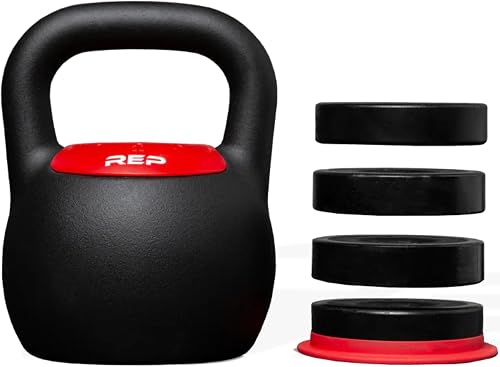
REP Fitness Adjustable Kettlebell
REP Fitness · 4.6★ from 148 verified ratings
- REP Fitness build quality — a serious home-gym brand
- Closer to true bell geometry than most adjustables
- Solid handle finish suited to chalk and hard sets
- Smaller owner base than the BowFlex — stated up front
Why we picked it: REP Fitness is one of the few brands home-gym owners name unprompted, and this bell is why: a shape and handle closer to a real cast kettlebell than the appliance-like competition, finished to a standard that survives chalk and dropped reps. This is the premium-first pick — we rank it here on brand record and geometry despite a 148-owner base, exactly as our sourcing standard now allows. Trade-offs: that thinner base, and a mechanism that takes marginally longer to change than a dial.
3. Best Value: Yes4All Adjustable Kettlebell Set, 20–40 lb

Yes4All Adjustable Kettlebell Set, 20–40 lb
Yes4All · 4.6★ from 942 verified ratings
- Solid cast-iron construction at the value tier
- 20 to 40 lb range covers most swing and press work
- 942-owner base at 4.6
- Simple mechanism with little to fail
Why we picked it: Yes4All’s set takes the low-tech route — cast iron and a straightforward plate system rather than a dial — and for a first adjustable bell that simplicity is a feature: fewer moving parts is fewer things that can loosen at the top of a swing. Nearly a thousand owners back it. Trade-offs: the range tops out where serious swingers are just getting started, changes are slower than a dial, and the finish is functional rather than refined — which is the honest trade at this tier.
Specs at a Glance
| Pick | Brand | Mechanism | Best for | Build | Owner base | See price |
|---|---|---|---|---|---|---|
| Best Overall | BowFlex | Dial, 6 settings | Most people | Swing-secure lock | 7,721 owners at 4.8 | Check price |
| Best Premium | REP Fitness | Adjustable plates | Bell feel purists | True-er geometry | 148 owners at 4.6 | Check price |
| Best Value | Yes4All | Plate system | First adjustable bell | Cast iron | 942 owners at 4.6 | Check price |
What Actually Matters
The swing test decides everything. Kettlebells get accelerated, inverted and caught. Any mechanism that can loosen under that is a safety problem, not a convenience problem — which is why we read this category’s negative reviews for ‘rattle’, ‘slipped’ and ‘came loose’ before anything else. Do the same with any listing you consider.
Adjustable bells are shaped differently. Most are wider and squarer than cast bells because the plates have to live somewhere. That is fine for swings and goblet squats, and more noticeable in the rack position and overhead. If cleans and jerks are your focus, prioritize geometry — our premium pick exists for that reason.
Range matters less than the top end. Nearly every adjustable covers the light settings well; what separates them is whether the maximum is enough a year from now. Swings and carries progress fast — buyers who train hard often end up pairing one adjustable with a single heavy cast bell rather than buying a bigger adjustable.
Learn the movements before loading them. Kettlebell swings are a hip hinge, not a squat or a front raise, and the technique is worth learning properly — from a coach or a good progression — before adding weight. Loading a poorly-hinged swing is how lower backs complain. Nothing here is medical advice.
Buyer’s Guide: How to Choose an Adjustable Kettlebell
The three picks above cover what most home lifters need. If you are weighing a different listing, run it through these checks in order — the first one can rule a bell out on its own.
1. Start with how the weight locks
There are three common designs. Dial systems leave the unused plates in a cradle and lock the selected ones to the handle. Pin or plate systems stack cast plates around a core and secure them with a pin or collar. Shell systems hide plates inside an outer bell. All three can be safe; what separates good from bad is whether the lock is positive (it clicks or pins into place) or relies on friction. Read the lowest reviews for “rattle,” “loose” and “came apart” before anything else.
2. Decide which lifts the bell is for
Swings and goblet squats forgive almost any bell shape. Cleans, snatches and the front rack do not — a wide, square body bangs the forearm and sits awkwardly on the wrist. If those lifts are central, favor the bell closest to cast-iron geometry even if it costs a slower change.
3. Look at the top weight, not the bottom
Almost every adjustable covers the light settings. The question is whether its heaviest setting will still be useful in a year. Two-hand swings progress fastest, so a bell that tops out in the middle range can be outgrown within months. If you already swing heavy, an adjustable may be the wrong tool and a single heavy cast bell the right one.
4. Check the handle window
Two-hand swings need a handle wide enough for both hands without pinching. The window between the handle and the body matters for one-arm work, too: too tight and the bell will not rotate cleanly around the wrist. Owner photos and reviews from people with larger hands are the best evidence.
5. Count the change time against your workout
A dial changes in seconds; a pin system takes longer. For circuits that move between weights every set, that difference adds up. For workouts that use one weight for a whole session, it hardly matters.
6. Read the finish reports
Paint that chips onto your hands, rough casting seams and slick coatings that will not hold chalk show up in reviews within a few weeks of ownership. They are not dealbreakers, but they decide whether the bell is pleasant to use.
What We’d Skip
Friction-only mechanisms. Any design where the plates are held by tightening a knob or collar with nothing that clicks or pins into place. A kettlebell gets accelerated and inverted; friction can let go.
Listings that hide the weight increments. If a listing will not say plainly which weights the bell offers and how big the jumps are, assume the jumps are large. Big jumps stall progress on presses, where small increases matter most.
Vinyl and sand-filled “kettlebells.” They are bulky for their weight, the handles are often thick and rough, and they are not adjustable anyway. They are not a substitute for either a cast bell or a well-made adjustable.
Buying an adjustable to save money at the heavy end. At the top of the range, one cast bell usually costs less than a larger adjustable and never loosens. Adjustables earn their place across the light and middle weights.
Setup, Space and Upkeep
Space to swing. A swing needs clear floor in front of you roughly as long as your arm plus the bell, and a ceiling that will not catch a bell at the top of a snatch. Train with nothing breakable in the arc and nobody walking behind you.
Floor. Kettlebells get set down hard, especially at the end of a set. A rubber mat protects the floor and the bell’s finish — our home gym flooring guide covers the options, and an exercise mat is enough for a single training spot.
Check the lock every session. Treat it like the collar on a barbell. Seat the handle, confirm the selected weight is locked, and give the bell a firm shake before the first rep.
Upkeep. Wipe chalk and sweat off the handle after use, keep dial mechanisms out of grit, and store the bell in its cradle or on the floor rather than on a shelf where it can fall. If a mechanism starts to rattle, stop using it until it has been checked.
Learn the hinge first. The swing is a hip hinge, not a squat and not a front raise. A few sessions spent learning the pattern with a light setting, ideally with coaching, pays off for every rep afterward. Nothing here is medical advice.
Who Should Buy Something Else
You mostly press, curl and row. Adjustable dumbbells cover those lifts better and go heavier. Start with our best adjustable dumbbells roundup, and if you like the BowFlex system, our BowFlex SelectTech review covers the whole lineup.
You want explosive conditioning without technique. A slam ball gives you hard, short efforts with almost nothing to learn and nothing to loosen.
You already have a fixed set of bells. Add one heavier cast bell rather than an adjustable. Our progressive overload guide explains why small, regular increases matter more than the number of weights you own.
You are building a whole gym in one go. Read the home gym build order first. For most people a kettlebell comes after a rack or dumbbells, not before.
Bottom Line: Which Should You Buy?
Most people: the BowFlex SelectTech 840. The best record in the category and a lock that survives swings.
Bell feel and build quality: the REP Fitness adjustable. Premium geometry and finish — smaller base, stated plainly.
First adjustable on a budget: the Yes4All set. Cast iron, simple, proven — know where the range ends.
Ready to buy?
Jump straight to our picks on Amazon — check the current price at click-through.
Frequently Asked Questions
What are the best adjustable kettlebells in 2026?
Short answer: the BowFlex SelectTech 840 — 4.8★ from 7,721 ratings. Its case: 4.8 across nearly 8,000 owners — the category’s best record. REP Fitness is the alternative worth comparing, with Yes4All Adjustable Kettlebell as the best value. All picks were verified on their live listings; availability and ratings move, so check before you buy.
Are adjustable kettlebells safe for swings?
The well-built ones are — and that qualifier is the whole answer. Mechanisms that lock positively (like our top pick’s dial) handle swings routinely; cheap systems that rely on friction do not. Inspect the lock before every session the way you would check a collar on a barbell.
Adjustable kettlebell or a set of cast bells?
Space and budget decide it. One adjustable replaces a rack of bells for a fraction of the footprint; cast bells feel better, cost less per bell, and never loosen. Many home gyms end up with one adjustable for variety plus one heavy cast bell for swings.
What weight should I start with?
Common starting points are a bell that lets you press comfortably for reps and swing for sets of ten to fifteen — for many adults that lands in the middle of an adjustable’s range, which is exactly why the format suits beginners. Progress by settings, not by ego.
Do adjustable kettlebells fit in the rack position?
Less comfortably than cast bells, because the wider body sits differently against the forearm. It is a real difference and a manageable one for most training; if front-rack work is central to your program, our premium pick’s geometry is the one to prioritize.
How heavy should an adjustable kettlebell go?
Enough that its top setting still challenges your two-hand swing after a few months of training. Swings progress faster than presses, so a bell that only covers your current pressing weight will run out quickly on swings. If your swing is already heavy, pair a lighter adjustable with one heavy cast bell.
Is the BowFlex 840 good for kettlebell swings?
Owner reports say yes. Its dial locks positively, and with 7,721 ratings averaging 4.8 it has the deepest record in the category. The trade-off is shape: the body is wider and squarer than a cast bell, which you notice more in the rack position and overhead than in swings.
How do you change weights on an adjustable kettlebell?
It depends on the design. Dial bells sit in their cradle while you turn a dial, then lift out with the selected plates. Plate and pin bells are taken apart and reassembled around a central core. Either way, confirm the lock before the first rep.


How We Research
Picks are researched and written by Mike Callahan based on manufacturer specifications, current Amazon listings, and patterns across verified owner reviews — particularly the negative ones. We are not a testing lab and do not claim to be; our full standard is in the editorial policy. Specifications and included accessories vary by listing, so confirm current details at the retailer before buying.
Note: Under our premium-first sourcing standard, the REP Fitness bell is ranked on brand record and geometry despite a 148-owner base, disclosed on its card. Mechanism security was treated as a disqualifying criterion rather than a ranking factor. Ratings verified on the live listings October 1, 2026.